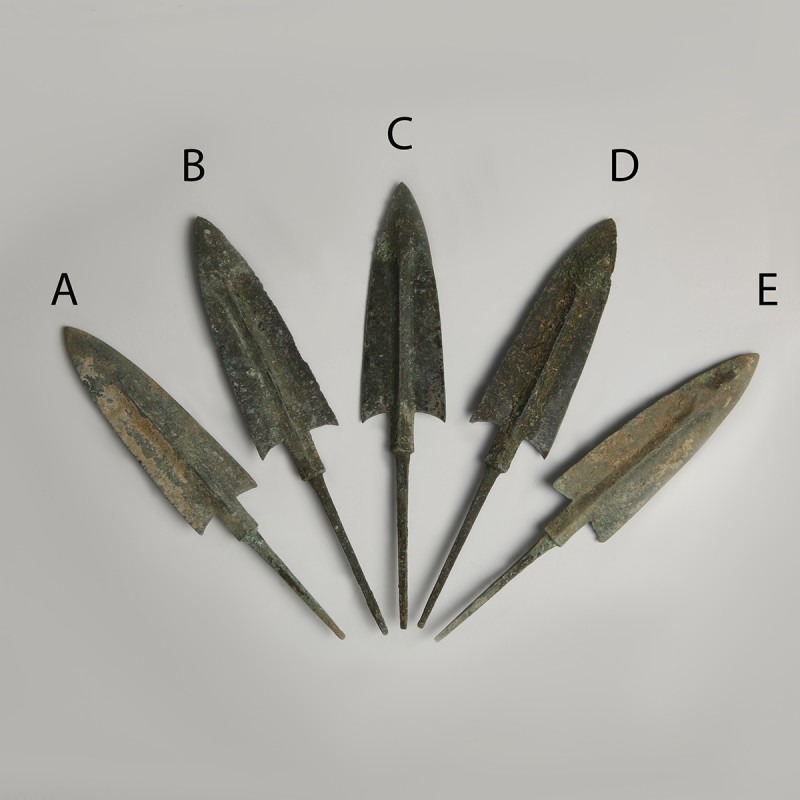
How to identify and arrowheads of America Date
Finding a Native American arrowhead can be an emotion for anyone interested in history. Archaeologists have discovered approximately 1,200 types of arrowheads that were used by Native Americans. Most of these arrowheads were used for hunting, but some were used during battle with other tribes. To identify the type of arrowhead you have and the time period it is from, you will need to know the material it is made of, the design and where it was found.
Instructions
1 Determine exactly where the arrowhead is by asking the person who gave you the arrowhead. If that person does not know, continue to track the buyers of the arrowhead until you find the original location. Identifying where the arrowhead was used will reduce the list of arrowhead types to around 200 options.
2 Determine what the arrowhead is made to further descend the location where the arrowhead most likely was. Some materials are native to specific regions, such as flint to Illinois.
3 Identify the shape of the arrowhead. Consider the shape of the mother if it is derived; If it is without stem, consider whether or not it is fluted. If you have notches in it, determine if the notches are on the side or the corners of the arrowhead.
4 Find a website or a book that identifies the types of arrowheads depending on the area where they are in the material they are made from and their design. One option is "Arrowheads and Stone Artifacts: A Practical Guide to Evaporation Capture and Amateur Archaeologist" by CG Yeager. Find the type of arrowhead that corresponds to your arrowhead and identify it. The book also shows the approximate date on which your particular type of arrowhead was made.

Types of arrowheads to hunt:
Of the thousands of arrowhead designs, a single kind of arrowhead is suitable for big game; In fact, with bad design is illegal. Fishing and hunting officials, however, are less particular about the designs used for small game hunting, as simple and classic designs are still as effective now as they have been for centuries.
broadheads
Broadheads are just that: they are a wide triangle of sharp cutting edges like blades. Often, the delta-shaped head is usually composed of three or more leaves. Hunting tips are the arrowhead of choice for hunting hunters. In fact, wide-headed are the only legal hunting big tip.
Types of Broadheads
broadhead designs are really a kind of arrowhead with many iterations on the subject. More or less, however, that can be divided into a few subcategories. A standard hunting tip is fixed and permanent blades. These designs usually lead with the pointed knife, similar non-bullet point, followed by flared cutting edges. Another subcategory is the removable blade, hunting point. These can look similar to a traditional bullet tip, with the addition of blades that look similar to the stabilizers in a cutting rocket. The last category is an extendable sheet. This is the most complex. It's a bullet-type tip. When you reach your destination, the cutting blades flanges open the wind path spins an umbrella upside down. The advantage is less resistance flying "open" blades, however, these require stronger ties, since they need a greater impact-energy to function.
Bullet
A bullet design is a classic, conical shape. The cone generally has a convex conical shape. These are also common range designs and work well with bail hair goals. They have an advantage over just target blunt heads, since they are aerodynamic, which gives you a precise range performance at the very tip that you can use for smaller game like the rabbit.
Countryside
A council field has a double cone, similar to the needle on top of the Chrysler building: it narrows, protrudes, then decreases again. This is essentially a repetition of the bullet design. However, the smaller main set-up gives it better penetration power so it is a good option for a less powerful bow.
Types of arrowheads and what they were used for
The arrowheads are archaeological artifacts that can be found throughout North America. These prehistoric hunting tools have been found on farms, construction sites and other areas where the soil has become older. There are many different types of seeing and for some it can be very valuable.
Covington
Covington arrowheads are typically five inches long with a triangular tip and curved base. The Covington arrowhead was named for the Texas area, where it was first discovered. This type of arrowhead is made with a lanceolate notch. The Covington arrowhead is one of the largest types, which means that it was most likely used for big game.
Boggy Branch
An arrowhead Boggy Branch is often found in the southeastern United States of Florida, Georgia and Alabma. This type of arrowhead goes back almost 9,000 years. The Boggy Branch arrowhead comes in two different types. The first type has triangular-shaped expansion with notches evenly spaced along each side. The base of this type Boggy Branch has a bulbous shape.
The second type of Boggy Branch arrowhead is located in a much larger area of the United States, which extends to Virginia. The second type of Boggy Branch arrowhead differs from the first in its smaller size and convex base. These arrowheads were probably used for the medium to big game.
Nolichucky
A smaller arrowhead from about 3,000 years ago is the Nolichucky. This type of arrowhead is named for the valley of the Nolichucky River in Tennessee. Many of these arrowheads have also been found in eastern North Carolina. The Nolichucky measures only about 1 or 2 inches long. It has a weak shoulder and slightly concave base. It is believed that the smaller arrowheads of this type have been used to kill smaller animals with a poison placed on the tip before it was shot in the animal.
Simpson mustache
The arrowhead of Simpson's mustache is one of the rarest types of arrowheads and is only found in Florida. This type of arrowhead has a very different shape. The tip of the arrowhead is rounded and little to reduce to the base. The base resembles a mustache with two different flares coming out of the base. The Simpson mustache goes back about 11,000 years and is believed to be used for hunting at close range.
Zephyr
A Zephyr arrowhead (also known as a Lampassas or Mohammed) is a medium-sized variety, measuring about 2 1/2 inches in length. This type of arrowhead is only found in Texas. The tip expands on one shoulder directly to a concave base. The Zephyr is believed to have been used as a point of atlatl dart, which is a point connected to a stick from 4 to 6 feet in length. Then the bar was launched in a range of up to 150 yards to kill game.